Standard AC Filter Sizes: A Simple Size Guide for Homeowners
If you have ever stood in the filter aisle at a hardware store staring at a wall of numbers and feeling completely lost, you are not alone. Finding the right filter for your HVAC system is one of those tasks that seems like it should be simple but trips up homeowners every time. Standard AC filter sizes follow a specific naming convention that can be confusing if you do not know what the numbers mean, and using the wrong size filter creates real problems for your system. This guide breaks it all down so you can find the right filter quickly and confidently every time.
Here is what we will cover:
- How AC filter sizes work: What the three numbers on every filter actually mean.
- Nominal vs. actual size: Why the number on the package is not the filter’s true measurement.
- The most common standard sizes: A quick reference for the sizes found in most homes.
- How to measure your filter: The right way to find your size if you are not sure.
- Filter thickness and MERV ratings: How depth and efficiency affect your options.
- When to call a professional: What filter issues point to a bigger system problem.
What the Numbers on an AC Filter Actually Mean

Every AC filter is labeled with three numbers separated by x marks, such as 16x25x1 or 20x20x2. These numbers represent the filter’s length, width, and depth, always listed in that order and measured in inches. The first two numbers describe the flat face of the filter that sits against the return air grille or air handler slot. The third number describes how thick the filter is. A filter labeled 20x25x1 is 20 inches long, 25 inches wide, and 1 inch thick.
Understanding this labeling system makes the filter aisle a lot less overwhelming. Once you know your three numbers, you are looking for one specific product rather than trying to figure out which of dozens of options fits your system.
Nominal vs. Actual Size: An Important Distinction
One of the most common sources of confusion around AC filter sizes is the difference between nominal size and actual size. The nominal size is the rounded number printed on the filter label and used for ordering and shelving. The actual size is the filter’s true physical measurement, which is almost always slightly smaller than the nominal size.
The EPA recommends replacing HVAC filters every 60 to 90 days, and getting the right size is the first step in making sure that replacement actually protects your system the way it should.
- Nominal size: The rounded label number used for purchasing, such as 20x25x1. This is what you search for and what appears on store shelving.
- Actual size: The true physical dimensions, typically about a quarter to a half inch smaller per side. A nominal 20x25x1 filter typically measures closer to 19.5×24.5×0.75 inches in actual dimensions.
- Why the difference exists: Filters are intentionally cut slightly smaller than the slot they fit into so they can be inserted and removed easily without bending or forcing.
When measuring your existing filter or filter slot, always round up to the nearest inch to find the correct nominal size to order.
The Most Common Standard AC Filter Sizes
While there are dozens of filter sizes in circulation, the majority of residential HVAC systems in the Upstate South Carolina area use a handful of the most common dimensions. Knowing where your system likely falls can save time when you are shopping.
| Nominal Size | Common Application |
| 16x20x1 | Compact return grilles, older homes |
| 16x25x1 | One of the most common residential sizes |
| 20x20x1 | Square return grilles, widely used |
| 20x25x1 | Larger return grilles, common in newer homes |
| 14x25x1 | Narrower return grilles, split systems |
| 20x25x4 | High-efficiency media cabinet filters |
| 16x25x4 | High-efficiency media cabinet filters |
| 20x25x5 | Whole-home filtration systems |
The 20x20x1 and 16x25x1 are the two most frequently used sizes in American homes, but your system may use something different. Always confirm before purchasing.
4 Steps to Find Your Correct AC Filter Size
If you are not sure what size your system uses, measuring is the most reliable way to find out. These four steps walk you through the process from start to finish.
1. Turn Off Your System First
Before removing your current filter, turn the system off at the thermostat. Running the system without a filter even briefly pulls unfiltered air and loose dust directly into the blower and evaporator coil, which can cause buildup that is difficult to clean and shortens the life of those components. We are proud to serve home and business owners in Simpsonville, SC, and nearby communities with AC filter replacement, maintenance, and more.
- Power down at the thermostat: Do not just set the fan to off. Make sure the system is fully shut down before opening the filter compartment.
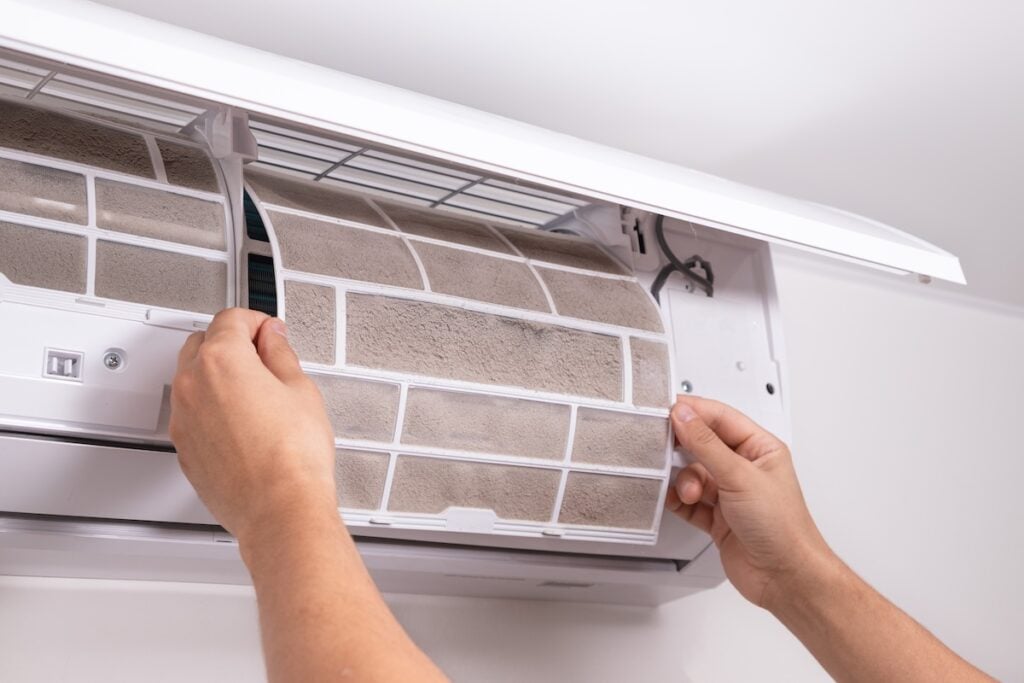
- Locate the filter slot: Common locations include the return air grille on a wall or ceiling, or the slot built into the side or bottom of the air handler unit itself.
- Note the airflow arrow: Before removing the filter, take a photo of the airflow direction arrow on the frame. Your replacement must go in the same direction.
2. Check the Existing Filter Label First
Before reaching for a tape measure, check whether your current filter already has its size printed on the frame. Most filters have the nominal size printed clearly on one of the cardboard edges. If the number is legible and the filter appears to fit properly with no buckling, warping, or large gaps around the edges, that printed size is what you need.
- Look on all four edges: The size is typically printed on one of the longer edges of the filter frame.
- Confirm the filter fits properly: A filter that is buckled, compressed, or showing visible gaps around the perimeter may not be the right size for your system, even if it has been in use for a while.
- Ignore a damaged or warped filter’s dimensions: A filter that has been forced into a slot it does not fit will give you inaccurate measurements. Measure the slot itself instead.
3. Measure the Filter Slot Directly
If the existing filter label is unreadable or you suspect the wrong size has been used, measure the slot itself using a tape measure. Measure the length, width, and depth of the opening, then round each measurement up to the nearest inch to find your nominal size.
- Measure all three dimensions: Length and width of the opening, plus the depth of the slot to confirm whether your system takes a 1-inch, 2-inch, or 4-inch filter.
- Round up to find nominal size: A slot measuring 19.75 inches rounds up to a nominal 20-inch filter. Do not round down or you risk a filter that is too small and allows unfiltered air to bypass it.
- Check the air handler label: Many air handler units have the filter size printed on a label near the filter slot, which can serve as a quick confirmation of your measurements.
4. Confirm Before Buying in Bulk
Once you have your size confirmed, it is tempting to buy a large quantity at once to stock up. That is a good habit, but worth confirming the size works well in your system before committing to a case of filters.
- Install one filter and inspect the fit: It should sit flat and snug with minimal gaps around all four edges. Small gaps of a fraction of an inch are normal and expected.
- Check airflow after installation: After restarting the system, airflow from supply vents should feel consistent. Weak airflow can indicate a filter that is too restrictive for your system or installed incorrectly.
- Then stock up: Once you have confirmed the fit and performance, buying three to six months of filters at once is a practical way to stay on schedule without repeated trips to the store.
Filter Thickness: 1-Inch vs. 2-Inch vs. 4-Inch Filters
Filter depth is one of the most important and most overlooked dimensions when choosing a replacement filter. Not all systems can accommodate every thickness, and using a filter that is too thick for your air handler slot can restrict airflow significantly.
Thicker filters generally last longer between replacements and capture more particles, but they require a compatible air handler cabinet to work correctly. Using a 4-inch filter in a system designed for 1-inch filters is not possible without modification.
- 1-inch filters: The most common depth in residential systems. Widely available, inexpensive, and compatible with the majority of standard return grilles and air handlers. Typically replaced every 1 to 3 months.
- 2-inch filters: Less common but used in some air handler models. Offer slightly longer service life than 1-inch filters with similar filtration performance.
- 4-inch and 5-inch media filters: Used in dedicated media cabinets built into the air handler. Capture particles more effectively than 1-inch filters and typically last 6 to 12 months between replacements. Require a compatible cabinet.
MERV Ratings and How They Relate to Filter Size
MERV ratings measure how effectively a filter captures airborne particles, with higher numbers indicating finer filtration. Most standard nominal sizes are available in a range of MERV ratings, so the size and the MERV rating are two independent decisions you make when buying a filter.
- MERV 1 to 4: Basic fiberglass filters. Capture large particles only. Not recommended for most homes.
- MERV 8: A solid baseline for most residential systems. Captures dust, pollen, mold spores, and pet dander effectively without significantly restricting airflow.
- MERV 11 to 13: Higher filtration for homes with allergy sufferers, pets, or air quality concerns. Confirm your system can handle the added resistance before upgrading.
- MERV 14 and above: Typically used in commercial or medical settings. Most residential HVAC systems are not designed for filters this restrictive.
Frequently Asked Questions About AC Filter Sizes
Filter sizing questions come up constantly, and the answers are usually simpler than homeowners expect once the nominal vs. actual size distinction clicks. Here are the most common ones we hear from homeowners across the Upstate.
What happens if I use the wrong size filter?
A filter that is too small leaves gaps around the edges where unfiltered air bypasses the media entirely, allowing dust and debris to reach the blower and evaporator coil. A filter that is too large will not seat properly and may buckle or block the slot. Both situations reduce system efficiency and can accelerate wear on internal components.
Can I use any brand as long as the size matches?
Yes, for standard 1-inch and 2-inch filters, the nominal size is consistent across brands. A 20x25x1 from one manufacturer will fit the same slot as a 20x25x1 from another. For 4-inch and 5-inch media filters, always confirm compatibility with your specific air handler cabinet before purchasing.
How do I know if my home uses a non-standard filter size?
If your measurements do not match any of the common sizes listed in this guide, your system may use a custom or non-standard size. This is more common in older homes, custom-built properties, or systems with unusual return grille configurations. Custom filters are available through specialty suppliers in virtually any dimension.
How often should I replace my AC filter?
Most 1-inch filters should be replaced every 1 to 3 months, depending on household factors like pets, allergies, and how often the system runs. Four-inch media filters typically last 6 to 12 months. Setting a calendar reminder is the most reliable way to stay on schedule.
Keep Your System Protected With Eastergard HVAC

Getting the right filter size is the foundation of good HVAC maintenance, but it is only one part of keeping your system running at its best. If you are unsure about your filter size, noticing reduced airflow even with a fresh filter, or simply due for a professional tune-up, Eastergard HVAC has been serving Greenville area homeowners since 1989.
Contact Eastergard HVAC today to schedule your service visit. Call or text us at 864-235-2935 or send us an email, and we will make sure your system is properly maintained and performing the way it should.
Recent Articles POSTS